
Blepharoplasty
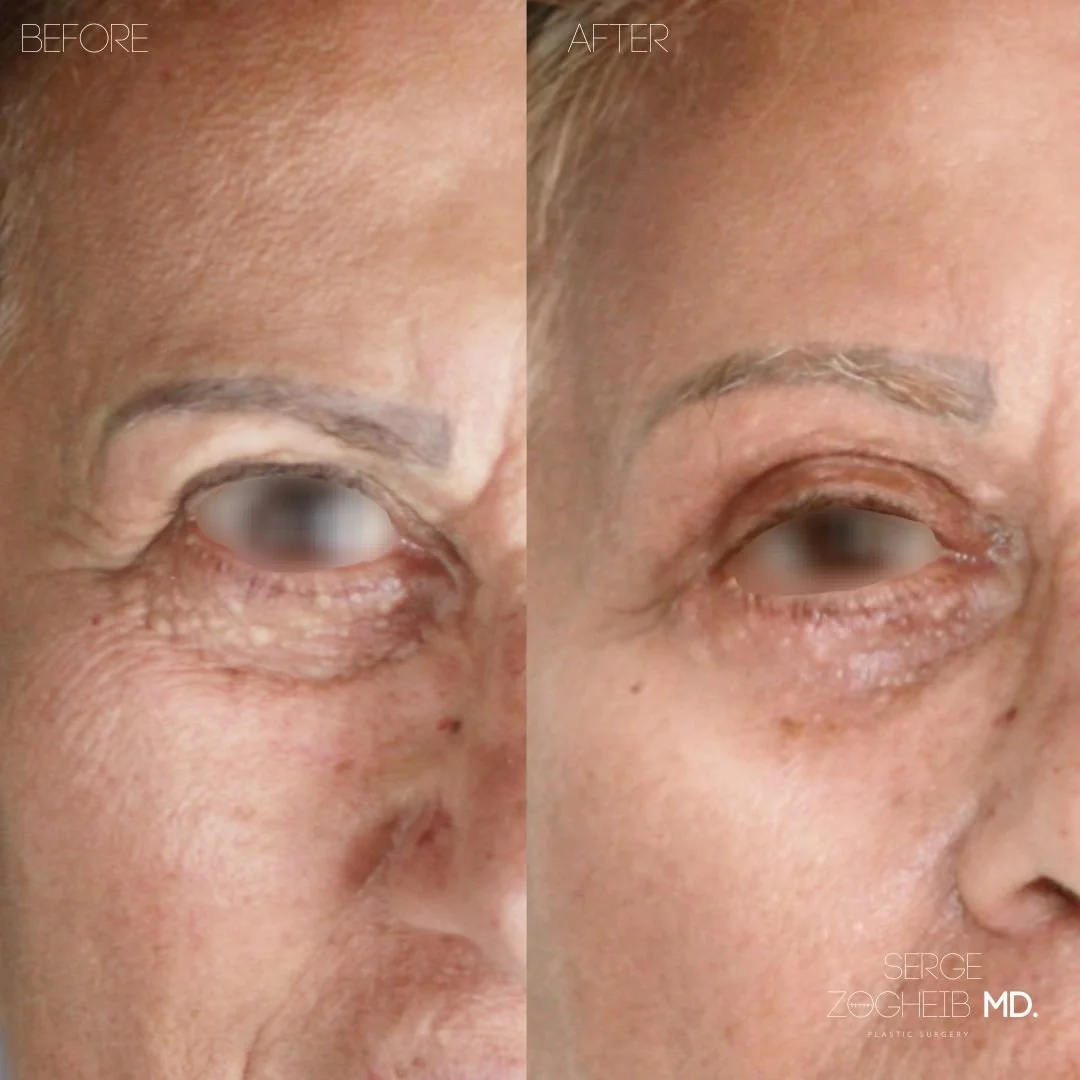
Eyelid surgery, commonly known as blepharoplasty, is not just about removing excess skin or treating under-eye bags. I have often found that a natural, harmonious rejuvenation requires a deep understanding of the entire periorbital region. Aging affects the eyes in multiple ways: bone loss around the orbit, fat deflation in the brows, temples, and cheeks, drooping brows, bulging fat pads, weak eyelid muscles, and a rounding of the outer eye corners. If only one component is addressed, the result often looks incomplete. In my practice, blepharoplasty is customized, and is one of the most rewarding facial plastic surgery procedures, both for my patients and me.
What can blepharoplasty treat?
Upper eyelids: excess or folded skin, heaviness, prominent fat pockets and, when present, associated eyelid ptosis.
Lower eyelids: under-eye bags, prominent orbital fat, tear-trough deformity, skin laxity and an irregular transition between the lower eyelid and cheek.
Combined with a comprehensive eye rejuvenation with canthopexy/canthoplasty, brow lifts and fat grafting.
Not every heavy upper eyelid needs more skin removed, and not every under-eye hollow needs volume added. Identifying which structure is responsible is an important part of planning surgery.
-
Upper blepharoplasty removes carefully measured excess skin from the upper eyelid and, when necessary, conservatively treats or repositions fat. The incision sits within the natural upper-eyelid crease. An important part of the examination is determining whether the apparent heaviness is actually caused by excess eyelid skin, a descended brow, true eyelid ptosis, or a combination of these. Blepharoplasty alone does not correct true ptosis, and removing additional skin cannot compensate for a low eyelid margin.
-
Lower blepharoplasty treats under-eye bags, prominent orbital fat, skin laxity and the transition between the lower eyelid and cheek.
I generally favor a fat-preserving approach. Rather than simply removing prominent eyelid fat, which can create or worsen hollowness, the fat can be repositioned across the orbital rim to soften the tear trough and create a smoother transition between the eyelid and cheek.
Depending on the anatomy, this may be performed through a transconjunctival incision hidden inside the lower eyelid, or combined with conservative skin treatment. Fat grafting and support of the outer eyelid with canthopexy or canthoplasty may be added when indicated.
-
Sometimes what appears to be excess upper-eyelid skin is partly caused by descent of the outer brow. Removing more eyelid skin in that situation does not correct the underlying problem and may produce an overly tight or skeletonized upper eyelid.
When lateral brow descent is significant, I may recommend a deep temporal brow lift, either alone or together with upper blepharoplasty. The aim is to reposition the brow rather than compensate for brow descent by removing additional eyelid skin.
-
Temple hollowing
Upper eyelid sulcus volume deficit, and brow deflation
Lower eyelid tear trough if you don’t have enough fat to transpose
-
A well-planned upper blepharoplasty should generally preserve the natural shape and identity of your eyes, not create a different eye. The amount and distribution of skin removed, preservation of volume, and the position of the brow all influence the result. In selected cases, eyelid shape or support can also be intentionally modified with additional procedures, but this is different from a standard upper blepharoplasty.
-
They treat different anatomical problems. Upper blepharoplasty removes excess eyelid skin, while a brow lift repositions a descended brow. Brow descent, particularly laterally, can push additional skin onto the upper eyelid and make it appear heavier. During consultation, I assess the brow and eyelid together because removing more eyelid skin does not correct a low brow, and some patients benefit from a combination of both procedures.
-
I generally favor preserving and repositioning lower eyelid fat rather than simply removing it. When prominent orbital fat sits above a tear trough, it can often be transposed across the orbital rim to smooth the transition between the lower eyelid and cheek. Selective fat removal can still be appropriate in some patients, the technique depends on the anatomy rather than applying the same operation to every lower eyelid.
-
Yes, in appropriately selected patients. When a tear trough is associated with prominent lower-eyelid fat and a distinct lid-cheek junction, the tear-trough ligament can be released and orbital fat repositioned across the depression. This allows us to address the anatomical transition rather than simply filling the hollow.
-
It shouldn't be the objective, but over-removal of eyelid skin or fat can produce a hollow or skeletonized appearance. This is one reason I favor a conservative, volume-preserving approach. In selected patients, existing volume deficiency may also be treated with fat repositioning or fat grafting as part of the overall periorbital plan.
-
Yes. Upper and lower blepharoplasty are commonly performed during the same operation when both areas require treatment. Depending on the anatomy, the procedure may also include fat transposition, fat grafting, ptosis correction, canthal support or a brow lift. The combination should be based on what each part of the periorbital region actually needs rather than routinely performing the same set of procedures.