
Breast Reduction/Mastopexy: Surgery & Recovery
Breast reduction surgery is frequently performed in our practice, and our standardized technique consistently delivers predictable results and promotes excellent healing.
A new areolar opening is created in a more optimal position.
Breast reduction is colored in yellow.
Am I a good candidate for breast reduction?
Good candidates should be in generally good health, have realistic expectations and preferably be at a stable weight.
Smoking significantly increases the risk of wound-healing problems and should be stopped before and after surgery.
Future pregnancy and significant changes in weight can alter the result and should be considered when planning surgery.
Patients responding to peer, spousal, or parental pressure, women <18 years and if there is a significant breast disease (severe fibrocystic disease, ductal hyperplasia, high-risk breast cancer), are generally not good candidates.
How is breast reduction performed?
Before surgery, markings are made with the patient standing to determine the new breast shape and nipple position.
In most of my breast reductions, breast and skin are excised from the outer, inferior and inner parts of the breast. The nipple is kept alive on an inner flap of breast, fat and dermis (red outline in the picture). This flap is rotated and suspended into the ideal nipple position into the Weiss pattern and the breast and skin are sutured again into an inverted T-scar.
Surgery is performed under general anesthesia and usually takes approximately 2–3 hours. The exact technique depends on the size and shape of the breast, the degree of descent and the amount of tissue that needs to be removed.
What is recovery like?
-
Breastfeeding may remain possible after breast reduction, particularly when the nipple remains connected to the underlying breast tissue. However, surgery can reduce milk production, and the ability to breastfeed cannot be guaranteed. If future breastfeeding is important to you, this should be discussed before surgery.
-
The tissue removed during breast reduction does not grow back, but the remaining breast continues to respond to changes in the body. Pregnancy, hormonal changes, significant weight fluctuations and aging can therefore affect both breast volume and shape over time.
-
Yes, but secondary breast reduction requires additional planning because the first operation changes the blood supply to the nipple and areola. Whenever possible, the previous operative report should be available so that the original technique and pedicle can be identified. When this information is unavailable, the surgical strategy needs to be adapted accordingly.
-
Complications can include:
Bleeding or hematoma,
infection
Delayed wound healing, especially at the T-junction
Unfavorable scarring
Fat necrosis
Partial or complete loss of the nipple–areola complex is rare but is a recognized risk, particularly with very large reductions or when circulation is impaired in smokers.
-
Temporary changes in nipple sensation are common. Sensation may be reduced, increased or simply feel different during the first weeks and months after surgery and often improves as the tissues recover. Permanent reduction or loss of sensation is possible, however, and the risk generally increases with larger reductions and greater nipple repositioning.
-
A supportive, non-underwired bra is generally worn for 6 weeks to provide support and reduce movement while the breasts heal.
-
Sleeping on your back is preferable during the early recovery period to avoid pressure on the breasts. Side sleeping can usually be resumed gradually once it is comfortable and the incisions are healing well. Sleeping directly on the breasts should be avoided for longer.
-
Walking is encouraged early after surgery. Lower-impact activity can then be reintroduced progressively. Running, heavy lifting, upper-body training and high-impact exercise usually require 6 weeks and should only be resumed once healing is adequate.
-
Most swelling improves considerably during the first few weeks, but the breasts continue to settle over several months. Early differences in shape, height or swelling between the two sides are common and should not be interpreted as the final result.
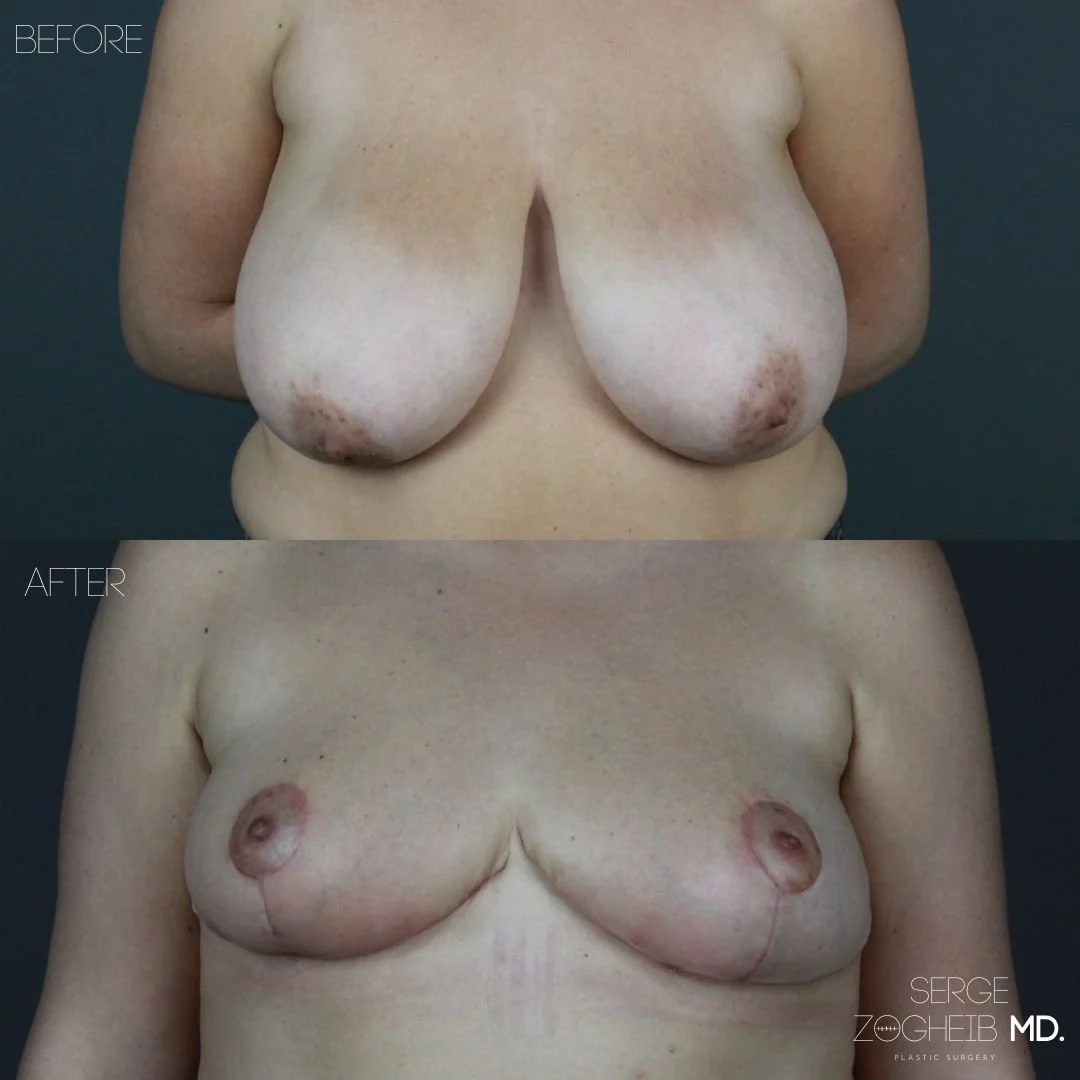
A typical breast reduction with an inverted T scar. This patient is at 2 months post-operatively. The scars are typically red during this period, they will fade in time.