Why I Rarely Use Hyaluronic Acid Filler in the Tear Trough
The under-eye isn’t simply an empty space underneath the eye
Treating every tear trough as a volume deficiency is extremely simplistic.
It is a transition zone between the lower eyelid and the cheek, and its appearance is determined by several structures sitting on top of each other: bone, retaining ligaments, orbital fat, muscle, subcutaneous fat and, finally, some of the thinnest skin on the face (less than 1 mm!).
The tear trough ligament creates a relatively fixed attachment between the skin and the underlying bone along the inner part of the lower eyelid. Further laterally, this transition continues through the orbitomalar ligament. Above this line sits the lower eyelid and orbital fat, and below it are the cheek and deeper facial fat compartments.
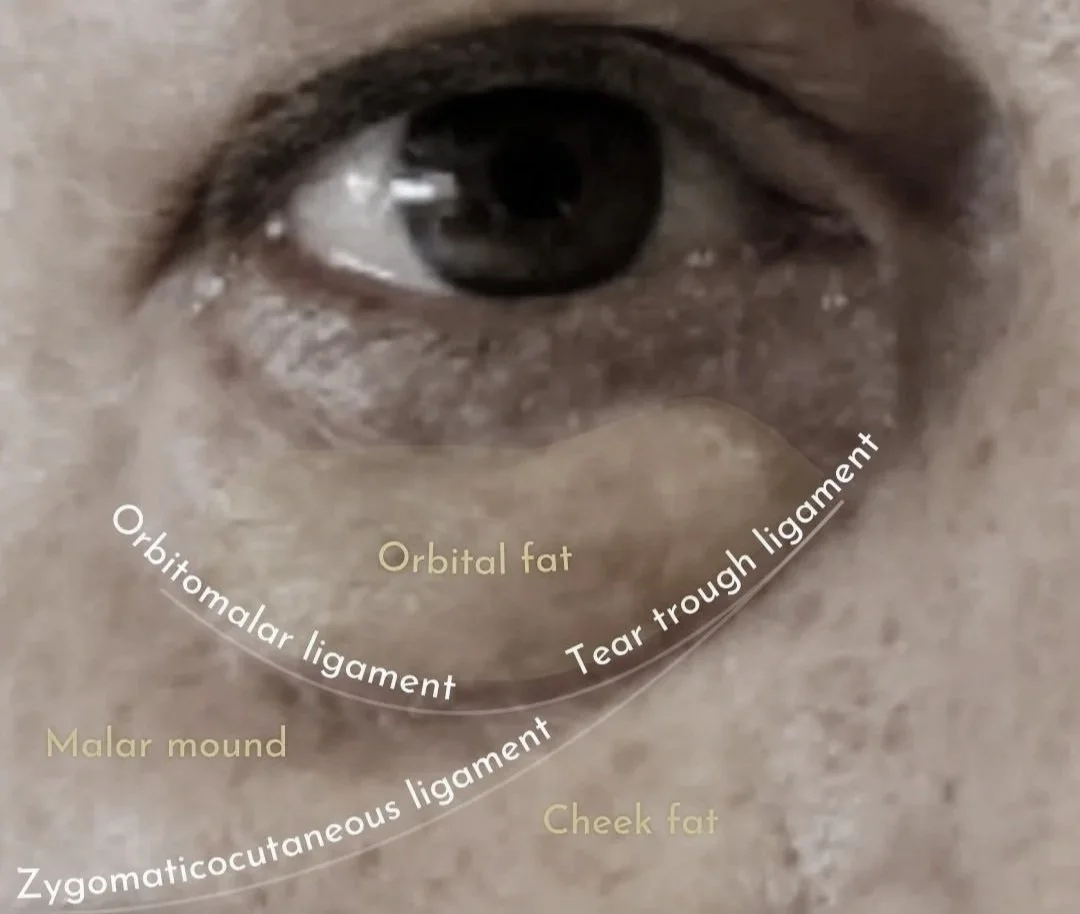
This difference in fixation between the eyelid skin and cheek skin is one of the reasons a shadow develops. With aging, several things can happen at the same time. Orbital fat may become more prominent, the lid-cheek junction becomes more visible, the cheek tissues descend, and changes in the underlying bone (maxilla and orbital rim) can further alter support. The skin itself also becomes thinner and less elastic.
The result can look like a "hollow," but the anatomy may actually be: a bulge above (eyelid fat) + a fixed attachment in the middle (tear trough ligament) + a relative depression below (cheek fat descent).
Why is the tear trough so hard to treat with HA fillers?
HA can worsen lower eyelid and malar edema: Lymphatic drainage in the lower eyelid and malar region is already notoriously poor. Adding hyaluronic acid in this confined area can further impair lymphatic drainage, both through the volume it occupies and its capacity to attract water. The result can be persistent malar edema and lower-eyelid puffiness, often most noticeable in the morning.
Superficial HA can become visible through the eyelid and produce the characteristic bluish-gray Tyndall effect by refracting the light through the filler.
HA filler does not always remain where it was injected: the eyelids are constantly moving every time we blink, and over time this movement can contribute to filler shifting into nearby areas. Depending on its position, HA can become visible as puffiness toward the inner corner of the eye or as swelling extending into the upper cheek. The natural ligaments around the eye also create boundaries where filler and fluid can collect rather than spread evenly. In rare cases, filler has even been found deeper inside the orbit, around the eye itself. This is one of the reasons the tear trough is such an unforgiving area to inject.
Ha can remain in facial tissues much longerthan expected: HA does not necessarily disappear according to the neat 6–12-month timeline patients are often given.
In a retrospective MRI study of 33 patients, residual HA was detectable in all patients despite no reported midface HA injections for at least two years. Twenty-one patients reported their last injection 2–5 years earlier, 12 more than 5 years earlier, four more than 8 years earlier, two between 10–12 years, and one patient reported no injections for more than 15 years.
Master M. Hyaluronic Acid Filler Longevity in the Mid-face: A Review of 33 Magnetic Resonance Imaging Studies. Plast Reconstr Surg Glob Open. 2024;12(7):e5934.A more recent systematic review including 24 studies and 1,410 patients with at least 12 months of follow-up also found persistence beyond the commonly quoted duration. Three-dimensional volumetric studies reported approximately 50–86% persistence at 24 months, while ultrasound studies could still detect filler at 12–36 months.
de Castro Costa M, et al. Clinical Durability of Hyaluronic Acid-Based Dermal Fillers for Facial Application: A Systematic Review. Aesthetic Plast Surg. 2026;50(5):1971–1993.
In other words, the visible effect may fade long before all of the filler has actually disappeared.
So why does tear-trough filler look good at first?
Because in the right patient, HA can be very effective at camouflaging the hollow. By adding volume beneath the depression, it smooths the transition between the lower eyelid and the cheek, reducing the shadow that makes the tear trough visible. The early result can therefore look excellent. The problem is that filler doesn't correct what created the hollow in the first place, it doesn't reposition eyelid fat, release the ligament, or restore descended cheek tissues, and repeated treatments over time can gradually turn a hollow into puffiness. In my own practice, I have yet to meet a patient with long-standing tear-trough filler who was truly happy with it.
What do I do when tear-trough filler becomes a problem?
When old HA filler is contributing to puffiness or an unnatural lid-cheek contour, I usually start by dissolving it with hyaluronidase, often under ultrasound guidance so I can identify where the remaining filler actually sits and treat it more precisely. Once the area has settled (2 weeks later), I prefer to reassess the underlying anatomy rather than simply refill the same space.
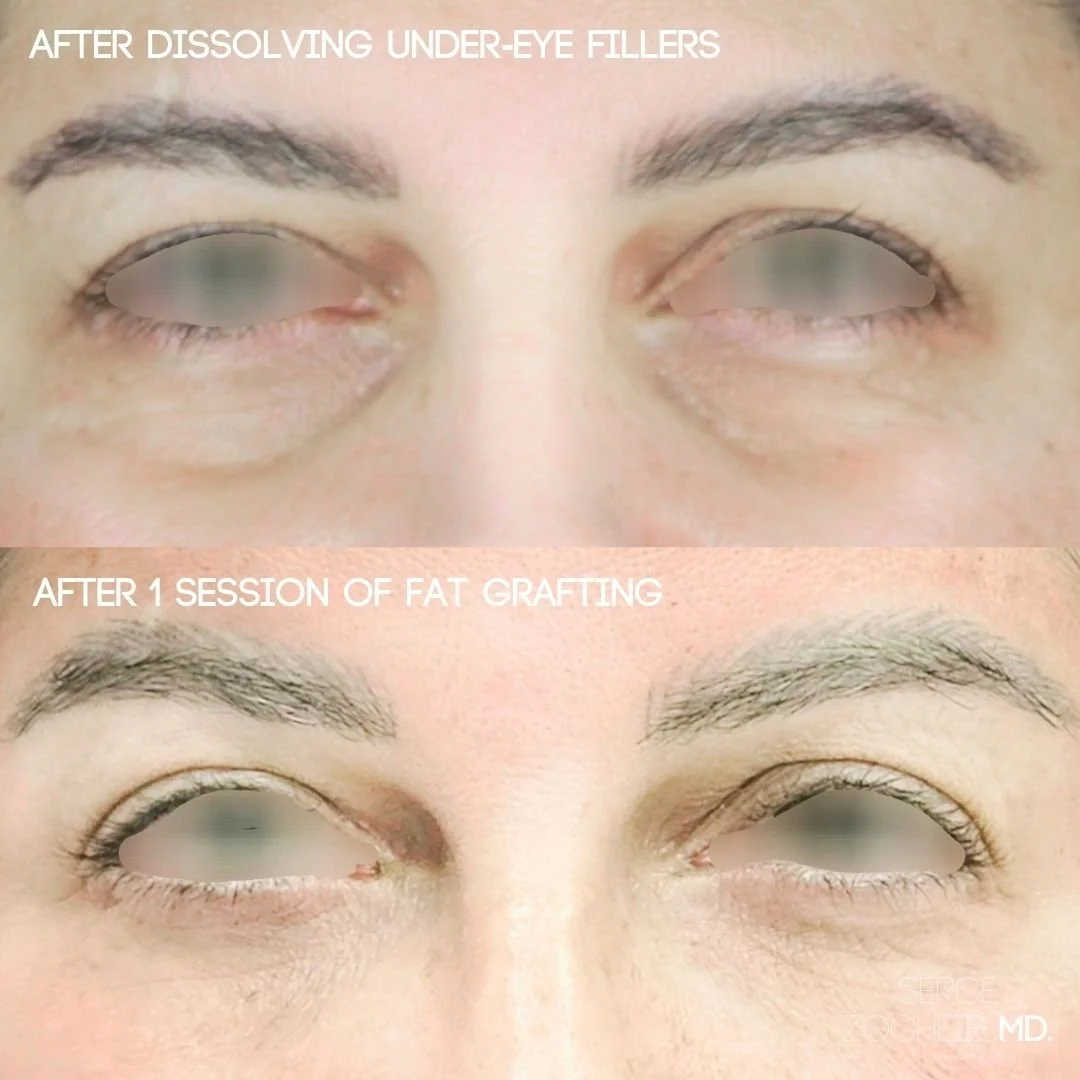
For a true volume deficiency, I may use microfat grafting (the patient's own tissue, without the Tyndall effect associated with superficial HA).
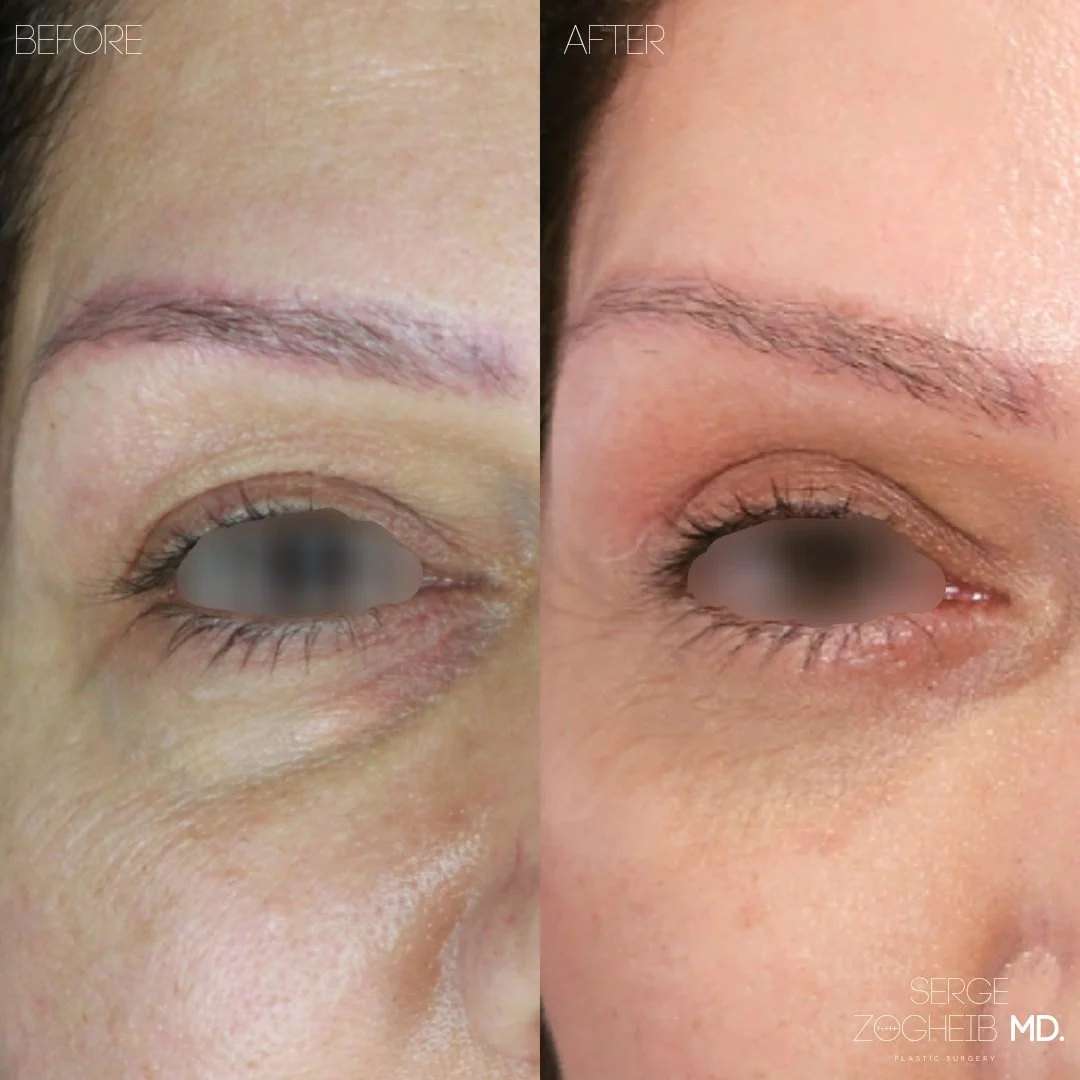
When prominent lower-eyelid fat and the lid-cheek junction are the main problem, I may instead perform a lower blepharoplasty with release of the tear trough ligament and eyelid fat transposition, using the patient's own orbital fat to smooth that transition.