Deep plane facelift and necklift
Are you a good candidate?
Facelifts are usually not a good option for patients with uncontrolled arterial hypertension, bleeding disorders or blood thinners or any other chronic untreated or uncontrolled longstanding condition.
Active smokers (up until a month before and after the surgery) have significantly more short-term side effects.
My own classification depends on anatomy
Patients usually fall within one of the three types.
In all type I and most type II, the scar stops behind the ear depending on neck skin laxity. These patients could also benefit from adjunct procedures such as blepharoplasty, temporal brow lift, lip lift and fat grafting, depending on the case.
The minority of type II and all type III candidates will have an additional horizontal incision below the chin (to treat the central neck), and an extension of the facelift incision in the posterior hairline and hair.
The association of fat grafting, lip lift, blepharoplasty and temporal brow lift will give a comprehensive global approach to reverse the aging process. The temporal brow lift is paramount when lifting the neck and face causes skin bunching around the eye.
Note that the earlier a facelift is performed, the more it lasts, as skin and SMAS are in a better state
-
Early jowls
Nasolabial fold prominence
Slight skin laxity
Excess submental fat
Usually early-late 40’s
-
Moderate jowls
Moderate skin laxity
Prominent nasolabial and labiomental creases
Usually late 40’s - Early 50’s
-
Significant jowls
Significant skin laxity
Vertical platysma bands
Usually late 50’s-60’s
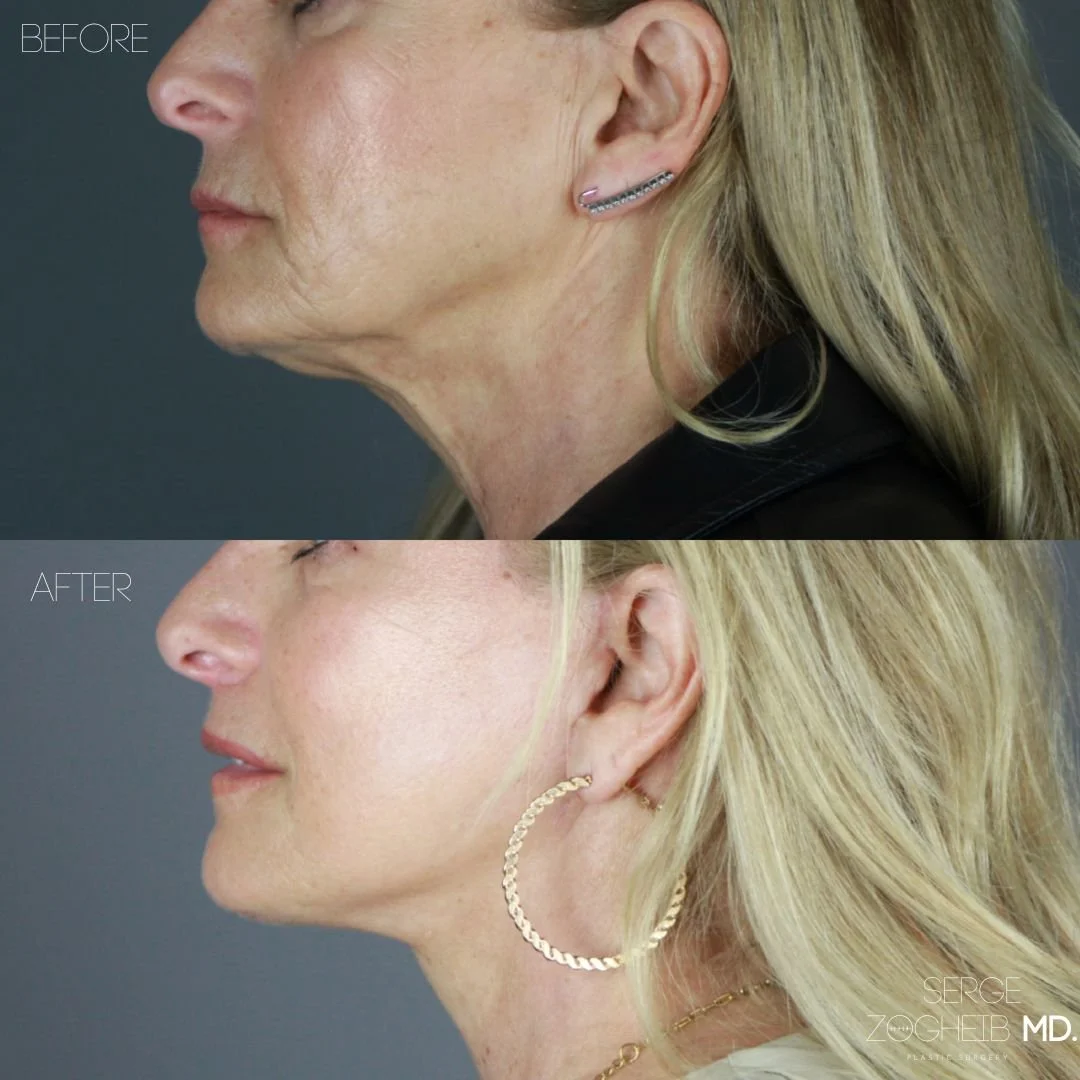
How does a deep plane facelift work?
A deep plane facelift repositions and tightens what has descended, which is not just skin. In fact, the fat and mimetic muscles are in a condensed resistant layer called SMAS. The deep plane, which is beneath the SMAS allows the release of retaining ligaments that hold the skin and SMAS and allows the composite skin–subcutaneous tissue–SMAS flap to move together with the objective is repositioning with less reliance on skin tension.

Red line = incisions around the ear and hairline
What about the recovery?
Usually under general anesthesia (depending on patient characteristics and surgical plan)
Lasts 3.5 to 5h (depending on the need for neck work or adjunct procedures)
10-14 day recovery period (7 days with swelling/bruises), swelling resolves slowly over 6-8 weeks. Final result is between 6-12 months as swelling resolves, tissues settle back down, and scars fade from red to skin-white.
Usually no trace of surgery at 4 weeks
Pain is usually mild and controlled with pain medication
A sensation of tightness is typical and usually lasts a few weeks.
Dimples on the skin that usually resolve within the first month.
Sensitivity of cheek and under the chin can be diminished for 6 months up to 1 year
Temporarily diminished motor nerve function (rare)
1st Follow-up: 24h (showers possible after that)
2nd Follow-up: 6-7 days (for suture removal)
3rd Follow-up: 3 months
Recovery timeline
-
Swelling is most prominent at 48-72 hours. You often have a puffy face at this time
You feel tightness, especially in the neck. Swallowing and breathing are not affected
Bruising is often normal at this stage but the face should feel soft. Any hard and/or expanding areas should warrant a check-up
Pain is usually mild and controlled with non-opioid pain killers
Neck movement should be limited (no extreme positions)
-
Swelling starts to decrease and is often present in the lower face at this stage, you might see your jowls and neck sharpness decrease because of that
Your face should look natural at his stage
Bruising is gone at this stage.
Tightness is often resolving as tissues settle and swelling decreases
Neck movement should still be limited at this stage
-
Swelling should still be present in the lower face, but should be resolving
Tissues start to settle and soften
You can start exercising normally (even swimming and heavy lifting at 6 weeks post-operatively)
-
The honeymoon phase of a facelift before tissues settle back down slightly
Swelling is gone, the face should feel very natural at this stage
-
Scars begin to fade
The lift often settles in its final post-operative position at 1 year post-operatively
-
A deep plane facelift repositions the deeper structural layers of the face, particularly the SMAS and its retaining ligaments, rather than relying on skin tightening or just a SMAS plication.
By releasing and elevating these deeper structures, the skin and SMAS move together as a single unit and the lift follows the natural direction of facial descent. This allows for more effective midface elevation, improved jawline definition, and less tension on the skin.
-
A facelift does not stop aging, but it definitely helps rewind the clock.
Because the deeper tissues are repositioned rather than simply tightened, the result tends to age more naturally over time. Most patients enjoy meaningful improvement for many years, depending on skin quality, lifestyle, baseline anatomy, as well as skincare follow-up.
Longevity is influenced more by structural correction than by skin tension.
-
When properly performed, yes.
By lifting the cheek and jawline as a unit, rather than pulling skin alone, the transitions between the lower eyelid, midface, and jaw remain smooth.
A well-executed deep plane facelift should not look “done.”
-
Candidates typically show descent of the midface, jowling, and loss of jawline definition. Skin laxity alone is not the only consideration,
During consultation, I assess facial proportions, skin quality, and vector of aging to determine whether a deep plane approach is appropriate. This is not an appropriate preventive treatment for facial aging.
Technique follows anatomy, not trends.
-
A facelift can include a lip lift, fat grafting and blepharoplasty depending on anatomy. Gaze tracking studies have shown that the center of the face is often the first area of attention, so rejuvenating the area around the mouth and eyes is often a great addition to a facelift.
Frequently asked questions in my practice
Further reading