
Lip lift in Beirut
The upper lip is defined by more than its volume. Its length, tooth show, vermilion exposure and relationship with the nose and lower face all contribute to its appearance.
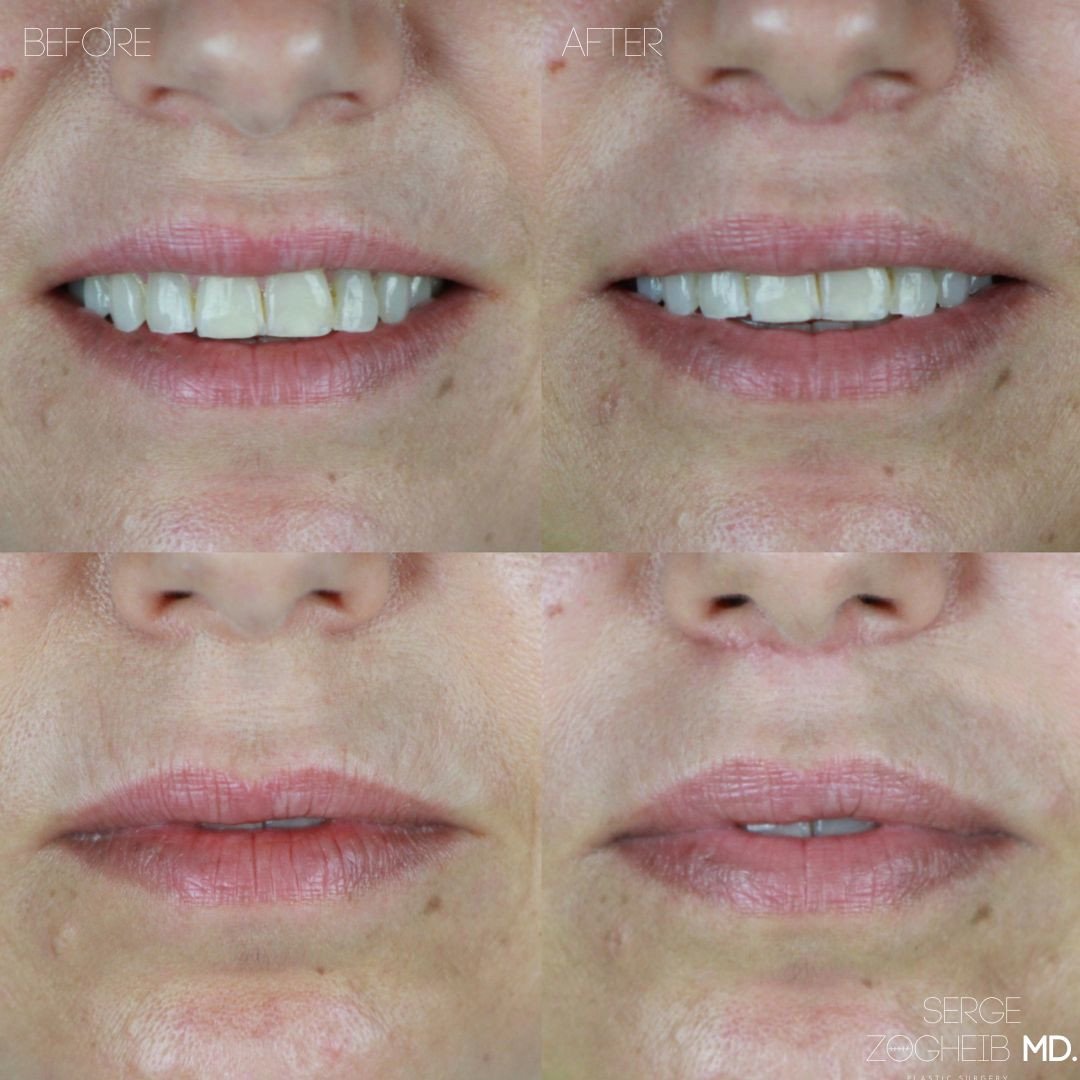
With aging, the upper lip can lengthen and turn inward, reducing both vermilion and upper-tooth show. Some younger patients simply have these proportions naturally. A lip lift addresses this by shortening the cutaneous upper lip and increasing vermilion and tooth show without relying on additional filler volume.
I plan the amount of lift according to the individual face rather than aiming for a predetermined lip length. The objective is a subtle improvement in proportion while preserving the natural shape and movement of the lip.
How is a lip lift performed?
In a subnasal or “bullhorn” lip lift, after local anesthesia, a carefully planned strip of skin is removed immediately beneath the nose. Closing the incision shortens the distance between the nose and upper lip, increases the visible height of the vermilion and everts it and usually increases upper-tooth show. The incision follows the contours of the nasal base so that the resulting scar sits within the transition between the nose and upper lip. The amount of skin removed is individualized. Even a few millimeters can produce a noticeable change in lip length, tooth show and vermilion exposure.
A lip lift does not primarily make the lip bigger. It changes its vertical proportions. However, eversion and increased vermilion exposure absolutely can make the red lip look fuller even without adding volume.
Lip lift or lip filler?
Lip filler and lip lift solve different problems. Hyaluronic acid filler primarily adds volume and changes lip shape or projection; it does not shorten an elongated cutaneous upper lip.
When the main problem is excessive upper-lip length with limited tooth show, repeatedly adding volume may make the lip heavier or more projected without correcting the underlying proportion. In these patients, I assess lip length and tooth show before considering additional filler. Volume and proportion are separate considerations.
Lip lift and fat grafting?
A lip lift corrects vertical proportion but does not replace lost soft-tissue volume around the mouth. When appropriate, I combine it with microfat grafting to address volume deficiency of the lips or surrounding perioral tissues.
These procedures therefore have complementary roles: the lip lift changes upper-lip length and vermilion exposure, while fat grafting can restore selected areas of perioral volume deficiency, including the nasolabial folds, prejowl sulcus and chin. Deeper folds and furrows can also be treated selectively with SNIF (sharp-needle intradermal fat grafting).

Who is a good candidate for a lip lift?
You may be a good candidate for a lip lift when you have:
A relatively long cutaneous upper lip or philtrum
Limited upper-tooth show at rest
Reduced vermilion exposure despite adequate lip volume
Age-related elongation and inward rotation of the upper lip
Age alone is not an indication for a lip lift. In my experience, however, the subnasal scar can sometimes remain more noticeable in younger patients, particularly under the age of 45, and I take this into consideration when discussing the trade-offs of surgery. I assess the lip in relation to the nose, teeth, lower lip and overall facial proportions before deciding whether shortening it would actually improve the face.
A lip lift is ultimately a trade-off: an improvement in upper-lip proportion in exchange for a permanent scar at the base of the nose. The incision is designed to follow the natural contours of the nasal base. In many patients it becomes inconspicuous as it matures, but scar quality varies with skin type, healing biology, surgical technique and postoperative care.
What is recovery like after a lip lift?
Swelling is most noticeable during the first few days and gradually improves over the following one to two weeks. The upper lip can initially feel tight, stiff or temporarily different when smiling. The lip gradually softens and settles as swelling resolves and the scar matures.
Bruising is expected to resolve within 10-14 days.
Suture with fine sutures under nose are removed at 5-7 days
Minimal pain with medication
1st Follow-up: 7 days to remove sutures
2nd Follow-up: 3 months (scar usually fades away in 6 months to 1 year)
-
A lip lift shortens the distance between the base of the nose and the upper lip (the white lip), increasing tooth show and enhancing the natural curvature of the vermilion.
It does not add volume.
It adjusts proportion. -
Fillers increase volume within the lip itself. They do not reduce the vertical height of the upper lip.
In patients with a long philtrum, filler alone often leads to projection without proportion correction and will often hide the teeth even more. A lip lift addresses the underlying vertical excess.
Volume and proportion are separate considerations.
-
The incision is typically placed along the base of the nose (subnasal or “bullhorn” pattern), following natural contours.
With proper technique and careful closure, the scar usually matures well and blends into the nasal base shadow. Scar quality depends on skin type, healing response, and postoperative care.
It is a trade-off, proportion improvement in exchange for a fine scar placed in a concealed location.
-
Candidates must have:
> 45 years old
A long upper white lip
Minimal tooth show at rest
Flattened Cupid’s bow
Adequate lip volume but poor vertical proportion
Assessment focuses on facial balance rather than isolated lip fullness.
-
A lip lift does not add volume to the lips. By shortening the upper lip and increasing the amount of visible vermilion, however, it can make the upper lip appear fuller and more defined. The change comes from greater exposure and slight eversion of the existing lip rather than from adding volume.
If additional volume is needed, fat grafting or hyaluronic acid fillers can be considered separately or combined with the lip lift.
-
Swelling is usually most noticeable during the first 2–3 days and improves progressively over the following week. Sutures are generally removed at around 5–7 days. Most patients feel comfortable going out and returning to normal social activities after approximately 7–10 days, although some residual swelling and redness around the incision may still be visible.
The lip can remain slightly stiff or swollen for several weeks, while the scar gradually softens and fades over the following months.