Why You May Need a Brow Lift Instead of an Upper Blepharoplasty
One of the most common reasons patients consult me is because they feel they have "too much upper eyelid skin.
Sometimes they're right. But sometimes the eyelid isn't the problem at all.
One of the most overlooked causes of heavy upper eyelids is a drooping brow. If this isn't recognized before surgery, removing eyelid skin alone may not produce the most natural result.
For me, surgery should restore anatomy, not simply remove tissue.
The Eyelid Should Never Be Evaluated Without the Brow
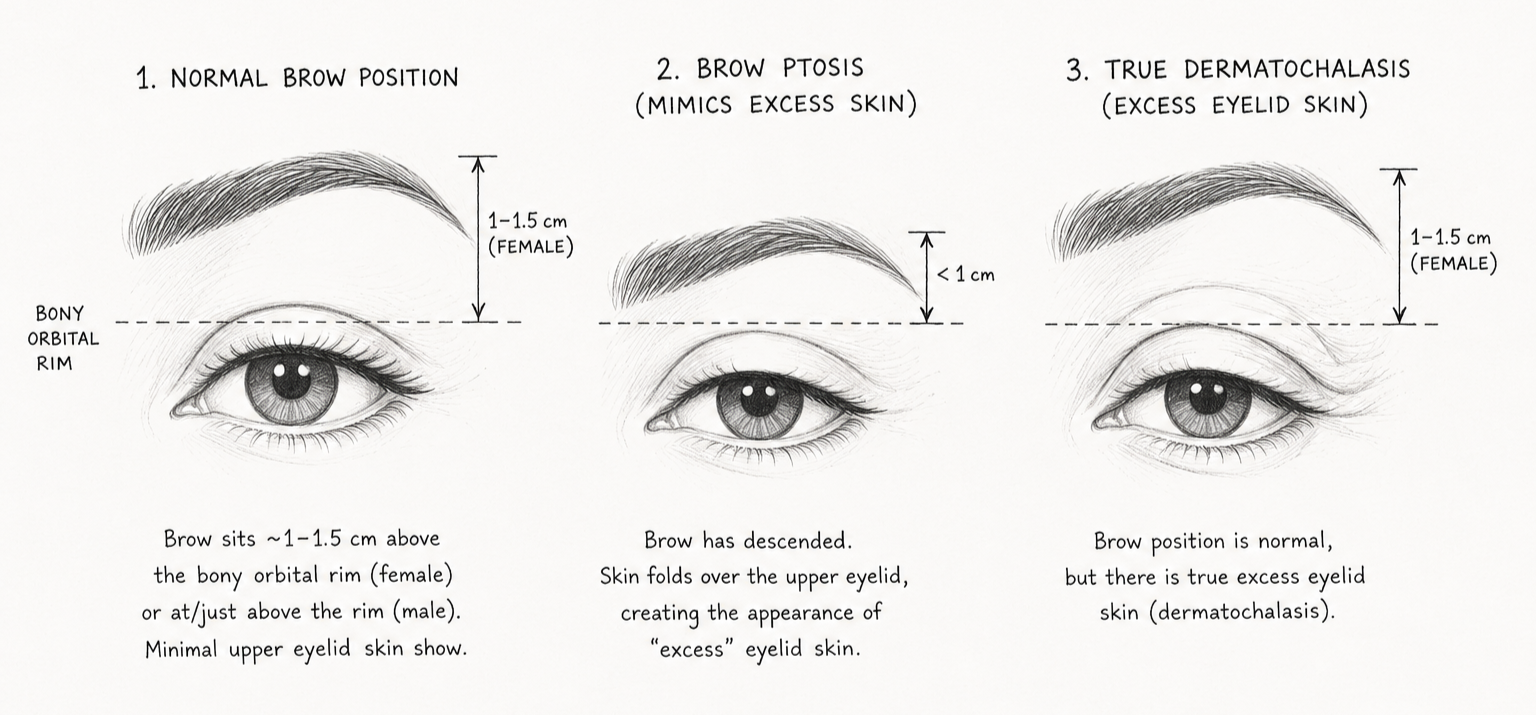
The brow and the upper eyelid function as one aesthetic unit. As we age, the lateral brow gradually descends. Because the brow sits directly above the upper eyelid, even a small degree of brow ptosis can push skin downward and create the impression of excess eyelid skin.
Many patients therefore believe they need an upper blepharoplasty, when in reality part of the problem originates higher up.
Think of It Like a Pair of Pants
Imagine you're wearing a pair of pants that seem too long. There are two possible reasons:
The legs of the pants are actually too long.
The waistband is sitting too low.
The result looks the same: the pants bunch up around your ankles, but the solution depends on identifying the real cause.
The upper eyelid works in much the same way. Sometimes there is genuine excess eyelid skin (dermatochalasis), meaning the "pant legs" are too long. Other times, the brow has descended, lowering the "waistband" and pushing the eyelid skin downward.
If the brow is the real problem, simply removing eyelid skin is like shortening the pant legs when all you needed to do was pull the waistband back up.
Understanding where the excess comes from allows me to choose the right operation, and often to perform a more conservative blepharoplasty with a more natural result.
A Clinical Clue: The Forehead Is Doing the Work
Many patients unconsciously raise their eyebrows throughout the day to compensate for brow descent.
This constant contraction of the forehead muscles helps keep the eyes open but often creates low horizontal forehead wrinkles. Try looking in the mirror while completely relaxing your forehead, you may be surprised by how much lower your brows actually sit!
One of the first things I ask patients to do during consultation is completely relax their forehead. Only then can the true position of the brow and the amount of excess eyelid skin be accurately assessed. In general, the ideal female brow sits approximately 1–1.5 cm above the bony orbital rim, while the ideal male brow rests at or just above the orbital rim.
Why an Upper Blepharoplasty Alone Isn't Always the Right Answer
If the brow is the primary cause of the heaviness, removing eyelid skin alone can actually flatten and hollow the upper eyelid and shorten the distance between the eyebrow and the lash line. The eye may appear less open rather than more refreshed.
In addition, removing too much skin leaves fewer options should the brow continue to descend naturally with age.For this reason, I believe that preserving eyelid skin whenever possible is just as important as knowing when to remove it.
This philosophy aligns with what is often referred to as preservation blepharoplasty, a more conservative approach that focuses on respecting normal anatomy and avoiding unnecessary tissue excision.
Rather than asking "How much skin can I remove?", I prefer to ask "How much skin do I actually need to remove?"
That principle has become an integral part of my surgical philosophy.
My Approach
Some patients only need an upper blepharoplasty. Some only need a brow lift. Many benefit from a combination of both procedures.
Rather than applying the same operation to everyone, I prefer to identify which anatomical structure is responsible for the heaviness and treat that first.