
Are You a Good Candidate for Blepharoplasty?
Blepharoplasty (eyelid surgery) is a safe and effective procedure for most healthy adults. It’s often combined with a temporal brow lift or even a facelift for full periorbital rejuvenation. However, certain factors should be considered to ensure the best results and a smooth recovery.
General Candidacy Criteria
You may be a good candidate for eyelid surgery if you:
Have sagging or excess upper-eyelid skin that affects appearance or vision
Have drooping eyelid margins (eyelid ptosis)
Have lower-eyelid bags, puffiness or a prominent tear trough
Have brow descent contributing to upper-eyelid heaviness
Are in good overall health and fit for surgery
Have realistic expectations about what surgery can achieve
Do not have uncontrolled medical or ophthalmological conditions that significantly increase surgical risk

Upper blepharoplasty, right true ptosis repair, lower transposition blepharoplasty and fat grafting to the brow and temples at 6 months post-operatively
Blepharoplasty Candidacy and Recovery
Important Considerations
Medical and lifestyle factors to consider:
Chronic dry eyes should be evaluated and managed by an ophthalmologist before surgery, as blepharoplasty may temporarily worsen ocular surface symptoms.
Laser vision correction (LASIK, PRK) should generally be scheduled at least 6 months before or after eyelid surgery.
Contact lenses should be avoided for 4 weeks before and after surgery to protect the healing eyelid tissues.
Blood thinners or supplements that may impair your clotting ability should be stopped one week before surgery with your doctor’s guidance.
Smoking and nicotine significantly impair wound healing and increase the risk of complications. I ask patients to stop all nicotine use for at least one month before and after surgery.
What to Expect after Blepharoplasty?
I typically perform both upper and lower blepharoplasty, ptosis surgery, fat grafting and temporal brow lift under local anesthesia with twilight sedation. The pain felt during surgery is limited to local anesthesia infiltration.
Pain: Minimal and manageable with pain medication
Swelling and bruising: Maximal at 48-72 hours then start to decrease progressively over the next month for swelling and over 10 days for bruising.
Dry eyes: You might experience a foreign object sensation in the eye or on the contrary, excessive tearing. Both are usually caused by dry eyes.
Aftercare:
Lubricating eye drops and ointment
Antibiotic + Steroid eye ointment
Rest, frequent icing with gel eye masks and sleeping with an elevated head of bed
Sunglasses are recommended outdoors, especially while bruising still shows.
Massaging the eyelid is started at 7 days to soften the scarring at the direction of your surgeon
Downtime:
Bruising and swelling for ~1 to 2 weeks (up to 3 to 4 weeks depending on patients and type of work)
Typically no visible signs of surgery after 3-4 weeks
Follow-Up Appointments
Days 5-7: Suture removal
6 weeks: Second check-up for monitoring, and referral for peels or lasers
3 Months: Final assessment
Where are the incisions:
Upper eyelid: Hidden in the natural eyelid crease
Lower eyelid: Placed just below the lash line or inside the lid (transconjunctival)
Deep temporal brow lift: 2 cm incision in the temporal hairline.
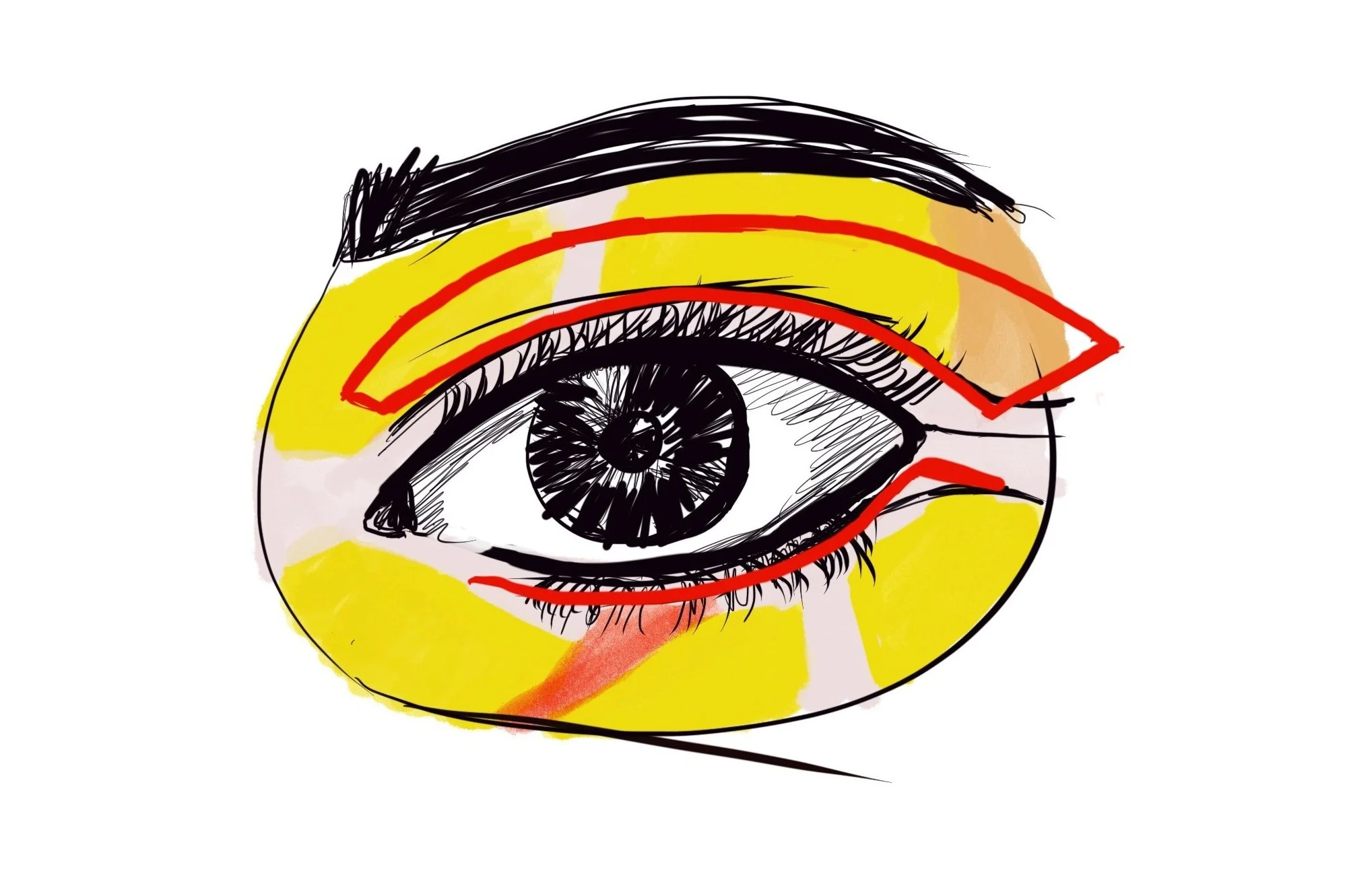
Red: incision lines; Yellow: fat pockets
-
Swelling and bruising are usually at their maximum.
Mild discomfort, tightness, watering, dryness or temporary blurred vision from ointment and swelling are common.
Regular cold compresses and head elevation help control swelling.
You should use the prescribed eye drops and ointment as directed.
-
Swelling and bruising gradually begin to improve.
External sutures are generally removed at approximately 5-7 days, when applicable.
Dryness, watering and sensitivity to light can still occur.
Sunglasses are useful outdoors, particularly while bruising remains visible.
-
Many patients feel comfortable returning to work and normal social activities.
Some residual swelling or bruising may remain, particularly after lower blepharoplasty, fat transposition or combined procedures.
-
The eyelids gradually soften and settle.
Lower-eyelid swelling and firmness can persist longer than upper-eyelid swelling.
Scars continue to mature over several months.
The final result should not be judged during the early postoperative period.
Recovery Timeline
Temporal Brow Lift Overview
Incision: Horizontal, hidden in the hairline (temporal region)
Goal: Gently lifts the outer third of the brow using deep tissue anchoring
for longer-lasting results
Headaches: Mild tugging or tightness; minimal pain (some patients might feel a headache for the first week to 10 days, this is usually temporary and responds well to over-the-counter pain relief)
Altered sensation in the forehead and hairline, due to sensitive nerve inflammation after surgery. This is usually temporary and takes around 3-6 months to resolve
Temporary weakness of forehead or eyebrow movement can occasionally occur due to irritation of the temporal branch of the facial nerve. When it occurs, it is usually temporary and improves as the nerve recovers.
Recovery:
Swelling and bruising for 2-3 weeks
Staples removed after 7 days
Second follow-up: At 3 months, to assess for symmetry and the need for botulinum toxin (great for maintenance of result)
Read more about upper and lower blepharoplasty and brow lifts here.
-
Upper blepharoplasty addresses excess skin and, when necessary, muscle or fat in the upper eyelid that can create heaviness or visual obstruction.
Lower blepharoplasty focuses on under-eye bags, fat protrusion, and skin laxity. In selected cases, fat is repositioned rather than removed to avoid a hollow appearance.
Each eyelid requires a different strategy.
They are related anatomically, but not treated the same way. -
Swelling and bruising are usually most noticeable during the first 48–72 hours and then gradually improve. Most patients look considerably better within 10–14 days, although subtle swelling, particularly after lower blepharoplasty, fat transposition or fat grafting, can persist for several weeks. The eyelids continue to soften and settle over the following months.
Early results are encouraging, final results require patience.
-
Most patients can return to non-strenuous work after approximately 7–10 days. You may physically feel ready sooner, but residual bruising or swelling can still be visible. Patients whose work involves significant physical activity may need longer.
I generally recommend avoiding strenuous exercise, heavy lifting and activities for 4 to 6 weeks that significantly increase blood pressure during the early healing period as they increase swelling and bruising.
-
Contact lenses should be avoided during the early healing period because the eyelids may be swollen, sensitive and temporarily dry. I usually allow patients to resume them once the eyelids are comfortable, swelling has sufficiently subsided and the ocular surface is stable. Glasses should be used in the meantime.
-
Eye makeup should not be applied directly over healing incisions. It can usually be resumed once the incisions are fully closed and healing normally, often at around 10–14 days, although I may recommend waiting longer depending on the procedure and healing.
-
Temporary dryness, irritation, watering, foreign-body sensation or fluctuating blurred vision can occur after blepharoplasty. Swelling, temporary changes in blinking and the ocular surface can all contribute. Lubricating drops and ointment are commonly used during early recovery. Persistent or worsening symptoms should be assessed, particularly in patients with pre-existing dry eye.
-
During the early recovery period, I recommend sleeping on your back with your head elevated, particularly while swelling is significant. Extra pillows or a wedge can make this easier. Avoid sleeping directly on the operated eyelids during the initial healing period.
-
Contact me urgently if you develop severe or rapidly increasing pain, sudden deterioration or loss of vision, rapidly increasing one-sided swelling, a tense or protruding eye, persistent significant bleeding, or increasing redness and discharge associated with fever or worsening pain.
Sudden visual deterioration or severe pain associated with rapidly increasing swelling is an emergency and requires immediate assessment rather than waiting for the next scheduled appointment.